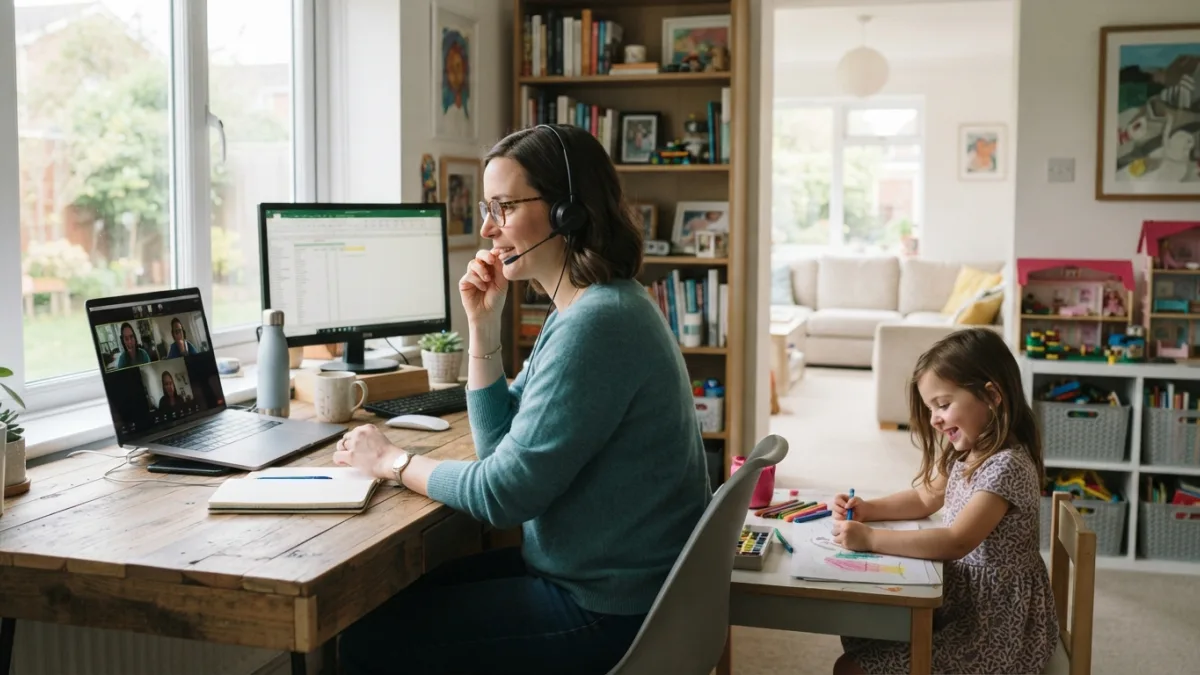
Remote Work Routine for Parents: 7 Easy Tips That Work
Your laptop is open, a deadline is close, and someone just yelled your name from the next room. Sound familiar? A steady remote work routine won’t make your kids quieter, but it can make your day far less chaotic. The goal is not a perfect, color-coded schedule that falls apart by 10 a.m. It is a simple rhythm that tells everyone in the house what happens next. Below, you will find seven practical tips that parents can adapt to any age group, any job, and any home size. Some ideas take five minutes to set up. Others take a few weeks to settle in. All of them aim to help you finish your work and still feel like a parent at the end of the day.
Working From Home With Kids: Why Standard Advice Falls Short
Working from home with kids is a different job from working from home alone, and most productivity advice ignores that. Typical tips assume long, quiet stretches of focus. Parents rarely get those. Instead, you get short windows, sudden needs, and constant switching between “employee” and “caregiver.” That is why a useful remote work routine starts with honest expectations. Toddlers need nearly constant supervision. School-age children can often play or study alone for short periods. Teenagers need less watching, but they still need meals, rides, and attention. Your job matters too. Fixed meetings and flexible tasks call for different plans. Before you copy anyone’s schedule, list which hours cannot move and which can. Then talk to your manager early about where you have flexibility. If you want to dig deeper, our guide on Remote Work Daily Schedule Template for a Focused 8 Hour WFH Day covers this in more detail.
7 Easy Tips to Build a Remote Work Routine That Holds Up
Tip 1: Create a Daily Schedule for Parents (and Kids)
A daily schedule for parents works best when it follows your family’s real energy, not an ideal day you saw online. Start by noticing when your children are calm, hungry, cranky, or busy. Then place your most demanding tasks in the calmest windows. Keep the plan simple: three or four blocks, such as morning focus, midday family time, afternoon tasks, and a shutdown hour. Leave gaps between blocks, because something always runs late. Post the schedule where your kids can see it. Younger children can follow pictures, while older ones can read the times. A plan that kids can see is a plan they can follow. Review it every Sunday, and change whatever did not work. Treat it like a draft you keep improving, not a contract you must obey.
Tip 2: Use a Naptime Work Schedule
If you have a baby or toddler, a naptime work schedule can give you the most reliable focus of your day. Learn your child’s sleep pattern and guard it. Save your hardest, most mentally demanding work for those quiet hours. Do not waste them on laundry or email you could handle while the child is awake. Prepare ahead: open the files, put your headphones nearby, and silence notifications before the house goes quiet. Sleep needs change as children grow, and the CDC’s sleep resources offer a helpful overview of why rest matters for kids. When naps shrink or disappear, shift to “quiet time,” where your child plays alone in a safe space. That keeps your remote work routine alive after naps end.
Tip 3: Design a Home Office Setup for Real Life
A good home office setup does not require a spare room. It requires a spot that signals “work mode” to you and to your family. A corner of the bedroom, a folding desk, or a section of the dining table can all work. Choose a place with decent light, a comfortable chair, and your screen at eye level. Keep a small basket of essentials nearby, including your charger, notebook, water bottle, and headphones, so you never wander off to search for them. If you share space with kids, face a wall or a window rather than the play area. Fewer eye-catching distractions help you stay focused. At the end of the day, pack up. That small ritual helps your brain switch off. This connects closely with another common issue — see How to Structure Your Day When You Work From Home for more on that.
Tip 4: Practice Setting Boundaries With Kids
Setting boundaries with kids is easier when the rules are visible, simple, and predictable. Young children cannot read a calendar, so give them a clear signal. A red card on the door can mean “I’m on a call,” and a green card can mean “come in.” Explain the rule in a calm moment, not in the middle of a meeting. Then practice it like a game. Give older kids a short list of what counts as an emergency. Always keep your promises about breaks: if you say “I’ll be done in 30 minutes,” show up on time. Kids test limits less when they trust you to return. Consistency matters more than strictness. Praise them when they respect the signal, even if they only manage it for ten minutes.
Tip 5: Stock Up on Screen Free Activities
Screen free activities can buy you real focus time without turning every workday into a tablet marathon. Build a “work-time box” with items your kids only see during your busy hours. Think puzzles, building blocks, stickers, coloring books, play dough, or an audiobook with headphones. Rotate the contents every week so the novelty stays fresh. Older children might enjoy a long-term project, such as a model, a comic, or a journal. Screens are not the enemy, and a show on a tough day is not a failure. The American Academy of Pediatrics shares family media guidance on HealthyChildren.org, which can help you decide what fits your household. The aim is balance, not guilt.
Tip 6: Plan for Handling Work Interruptions
Handling work interruptions starts with accepting that they will happen, and then making them less costly. Break your tasks into small pieces so a two-minute disruption does not erase an hour of progress. Keep a running note of where you stopped and what comes next. Schedule calls during your most predictable hours, and tell colleagues openly that a child may wander in. Most people understand, and many have been there. Use headphones with a good microphone to reduce background noise. When a real need arises, deal with it kindly, then return to your list. Being flexible is part of a sustainable remote work routine, and berating yourself for every interruption only drains energy you need for the next task. You might also find our article on The Perfect Morning Routine for Remote Workers (Step-by-Step) helpful here.
Tip 7: Make Space for Parent Burnout Prevention
Parent burnout prevention is not a luxury. It is part of how you keep working and parenting without falling apart. The World Health Organization describes burn-out as a result of chronic workplace stress that has not been successfully managed. Add a full household to that stress, and the risk grows. Protect small pieces of recovery: a real lunch away from your desk, a ten-minute walk, an early bedtime, or a few quiet minutes with coffee. Share chores clearly with your partner or other family members. Say no to optional commitments when you are stretched. If exhaustion, irritability, or hopelessness lasts for weeks, talk to a doctor or a mental health professional. Asking for help is a sign of good judgment.
A Sample Remote Work Routine You Can Copy and Adjust
Here is one example of how a remote work routine might look for a parent with a preschooler and a school-age child. Treat it as a starting point, not a rule. Your hours, your job, and your children will shape the final version. The key idea is to alternate between focus and family, with short buffers so small delays do not wreck the day.
- Early morning: Get dressed, eat breakfast together, and review the day’s plan with the kids.
- Morning block: Do your hardest work while the older child studies and the younger one plays with the work-time box.
- Midday break: Cook lunch, go outside, and give the kids your full attention.
- Quiet-time block: Handle calls and deep tasks while the younger child rests.
- Late afternoon: Answer messages, tidy your notes, and plan tomorrow.
- Shutdown: Close the laptop, say it out loud, and switch to family time.
Final Thoughts: Start Small, Then Adjust
You do not need to launch all seven tips on Monday. Pick one or two that solve your biggest daily headache, try them for a week, and see what changes. Maybe that means a visible schedule on the fridge, or a protected nap window, or a basket of quiet toys. Then add another piece. Every family’s remote work routine ends up looking different, and that is exactly how it should be. Some days will go smoothly, and others will fall apart before lunch. Both are normal. What matters is that you keep adjusting with patience and a little humor. Your kids will remember the time you spent together long after they forget the missed meeting. For a related walkthrough, check out Pomodoro Technique: 7 Proven Timer Settings for Remote Work.
Frequently Asked Questions
How long does it take to settle into a remote work routine with kids?
It varies by family. Many parents notice small improvements within a week or two, but a routine that feels natural can take longer. Expect to adjust it when school terms, nap patterns, or work demands change.
What if my job has meetings at unpredictable times?
Share your constraints with your manager and ask for as much notice as possible. Prepare a backup plan, such as a partner, a relative, a sitter, or a special activity kit your child only uses during surprise calls.
Can I work while my toddler is awake?
Sometimes, for short periods. Toddlers need frequent attention, so plan light tasks like email or planning for awake time. Save deep focus work for naps, early mornings, evenings, or times when another adult can help.
How do I stop feeling guilty when I use screens to get work done?
Remember that an occasional show or game during a busy hour is a practical choice, not a parenting failure. Pick age-appropriate content, set time limits you can live with, and balance it with play, outdoor time, and conversation.
What is the easiest first step for a new remote work routine?
Write down your fixed work hours and your children’s key times, such as meals, naps, and school. Then place your most important task in the calmest window. That single change often makes the whole day feel more manageable.