Small Home Office: 7 Best Desk Ideas to Save Space
A cluttered home office can make even the calmest person feel a little frazzled, and that’s exactly the problem so many people run into when they try to squeeze a work desk into a spare corner of their apartment or bedroom. If you’re furnishing a small home office right now, you’ve probably already searched for space-saving desk ideas and landed on two popular contenders: the floating desk and the corner desk. Both promise to help you reclaim square footage, but they solve the space problem in different ways, and picking the wrong one can leave you with a room that still feels cramped six months later.
Before you buy anything, it helps to think about how you actually move through the room. A small office layout isn’t just about the desk itself; it’s about the walking path around it, the chair space behind it, and whether you can still open a closet door or a window without bumping into furniture. A floating desk mounts to the wall and frees up the floor underneath, while a corner desk tucks into an unused angle of the room and leaves the rest of the space open. Both approaches work, but they shine in different room shapes, and that’s the real question worth answering before you commit to either style. If you want to dig deeper, our guide on Small Home Office Ideas for Remote Workers in Studio Apartments covers this in more detail.
7 Best Desk Ideas to Save Space in a Small Home Office
1. Floating Desks
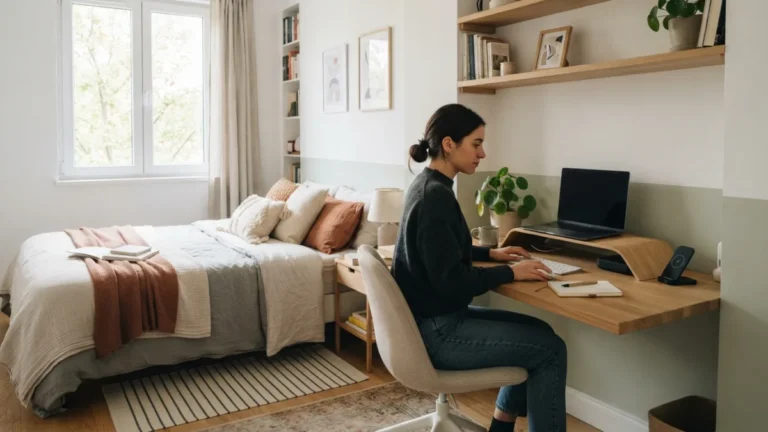
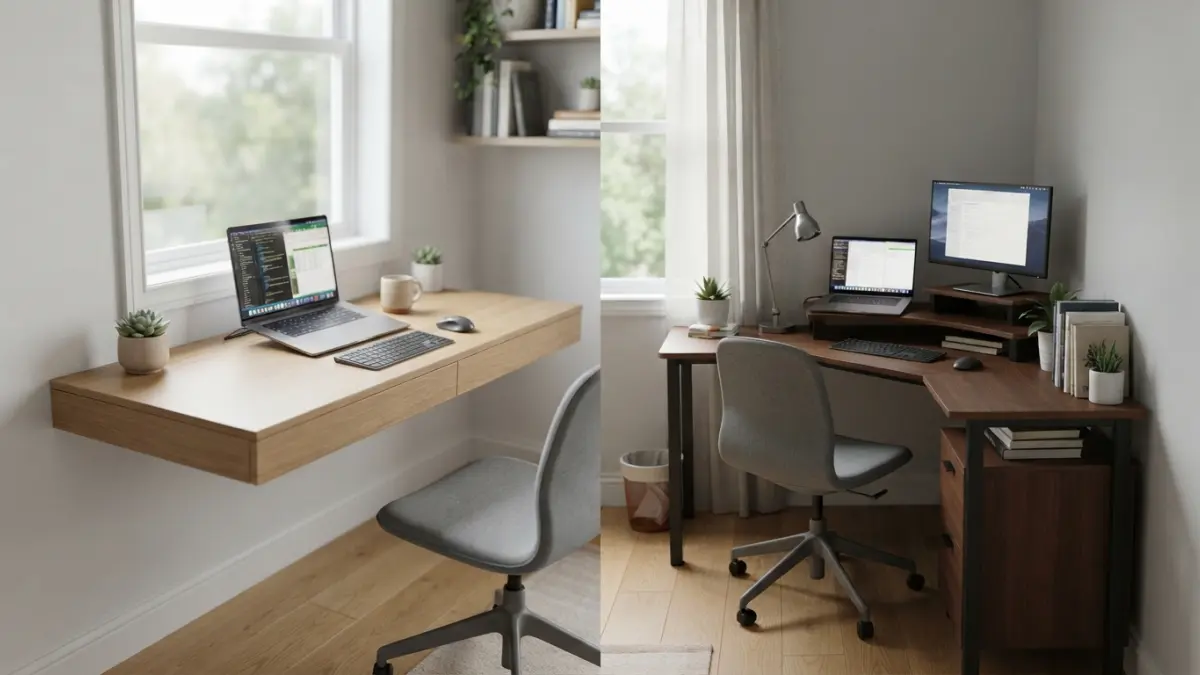
A floating desk is essentially a flat surface bolted directly to the wall, with no legs touching the ground. Because there’s nothing underneath, you can slide a chair fully under it or store a small bin or box beneath the surface when you’re not working. This makes it a strong pick for a small home office where every square inch of floor matters, especially in studio apartments or shared bedrooms. The main tradeoff is installation: you’ll need studs strong enough to hold the weight, and heavier desks may require extra brackets. Renters should also check their lease before drilling into walls, since some buildings restrict permanent wall mounts.
2. Corner Desks
Corner desks take advantage of the one part of most rooms that usually goes to waste: the corner itself. By angling the work surface into that dead zone, you keep the rest of the room open for a bookshelf, a reading chair, or simply walking space. This style tends to offer more usable surface area than a floating desk of similar footprint, since the L-shape or triangular design stretches along two walls at once. The downside is that corner desks usually stand on legs, so you lose some floor storage underneath, and they can feel bulky in a very tiny room where the corner is the only open spot to begin with.
3. Wall-Mounted Fold-Down Desks
If you like the idea of a floating desk but want the option to reclaim the wall entirely, a fold-down desk is worth a look. These hinge flat against the wall when you’re done working and unfold into a full desktop when you need it. They’re popular in tiny apartments, guest rooms that double as offices, and craft rooms where the space serves more than one purpose. The main limitation is weight capacity and desktop size; most fold-down models aren’t built for heavy dual-monitor setups, so they suit laptop users and light paperwork better than anyone running a serious multi-screen workstation. This connects closely with another common issue — see How to Set Up a Home Office in a Small Apartment for more on that.
4. Slim Ladder or Console Desks
Ladder desks and narrow console-style desks are built shallow, often just 16 to 20 inches deep, which makes them ideal for hallways, closets converted into offices, or awkward slivers of a room. Some ladder desks include built-in shelving above the desktop, giving you vertical storage without adding a separate bookshelf. This style won’t offer as much surface area as a corner or floating desk, so it works best for people who mainly use a laptop and a notebook rather than physical files and multiple monitors. It’s a smart middle-ground option when neither a full floating desk nor a corner desk fits your room’s dimensions.
5. Compact L-Shaped Corner Desks
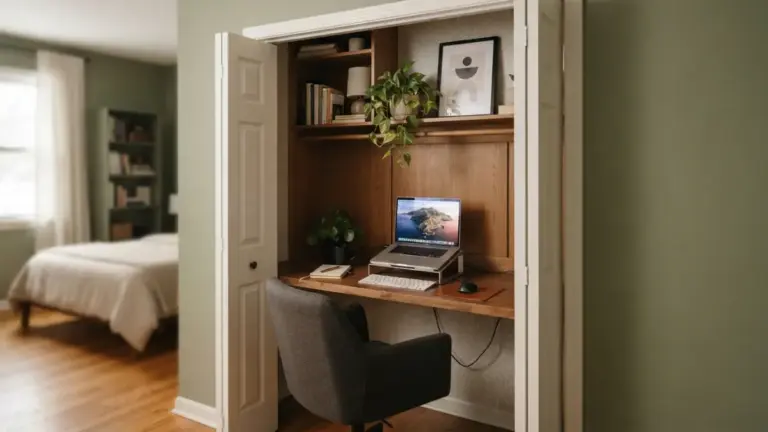
A smaller cousin of the traditional corner desk, the compact L-shaped version is designed specifically for tight rooms rather than open-plan offices. Manufacturers have scaled down the classic L-shape so it fits into small home office nooks, home offices carved out of a bedroom corner, or even a closet with the doors removed. You still get two work surfaces meeting at an angle, which is handy if you want a computer on one side and paperwork space on the other. Just measure carefully, since even “compact” L-shaped desks can eat up more room than shoppers expect once the chair and walking space are factored in.
6. Murphy-Style Desks That Fold Into a Cabinet
Borrowing an idea from Murphy beds, some furniture makers now build desks that fold up and disappear into a wall-mounted cabinet when not in use. This is one of the most dramatic space-saving desk ideas available, because the entire workstation can vanish, leaving the room to function as a guest bedroom, nursery, or living area the rest of the day. The cabinet itself does take up wall space permanently, and the setup can be pricier than a basic floating desk or corner desk, but for multi-purpose rooms it solves the small home office puzzle better than almost any other option on this list. You might also find our article on Ergonomic Home Office Essentials Under 0 helpful here.
7. Adjustable Standing Desks for Modular Layouts
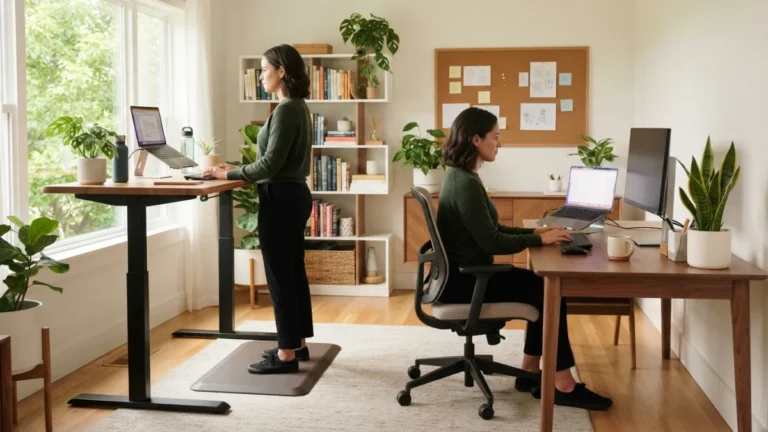
Standing desks aren’t only about health benefits, though the ergonomic advantages are well documented by resources like the Occupational Safety and Health Administration’s ergonomics guidance. Many modern standing desks come in narrow, foldable, or wall-adjacent designs that work well in small rooms, since you can push them flush against a wall when sitting isn’t needed. Some models even attach to the wall like a floating desk while still offering height adjustment. If you split your time between a laptop and video calls, a compact standing desk gives you flexibility that a fixed corner desk simply can’t match, though you’ll want to check weight limits before adding a heavy monitor arm.
Floating Desk vs Corner Desk: Side-by-Side Comparison
Once you narrow your choices down to the two most popular options, it helps to see them laid out side by side. The table below breaks down the practical differences that matter most when you’re trying to save space in a small home office, from floor clearance to installation effort and overall cost.
| Feature | Floating Desk | Corner Desk |
|---|---|---|
| Floor space used | Very little; floor stays open underneath | Moderate; legs and frame take up floor area |
| Installation | Requires wall mounting into studs | Usually freestanding, no installation needed |
| Surface area | Smaller, single flat surface | Larger, often L-shaped or angled |
| Best for | Studios, rentals with light desk needs | Rooms with an unused corner and more storage needs |
| Mobility | Fixed once mounted | Can be moved or rearranged easily |
| Approximate cost | Lower to moderate | Moderate, can rise with added storage features |
So, Which Saves More Space in a Small Home Office?
There isn’t a single winner that works for every room, but there is a clear rule of thumb. If your small home office is a narrow space, like a slice of a bedroom or a hallway nook, a floating desk usually wins because it clears the floor entirely and makes the room feel less boxed in. If you have an actual unused corner and want more desktop space for a printer, monitor, or paperwork trays, a corner desk makes better use of that dead zone without sacrificing much walking room elsewhere. Many people also mix ideas from this list, pairing a shallow floating shelf with fold-down flexibility, to match their exact layout rather than forcing one style to do everything. For a related walkthrough, check out Best Budget Desk Setups for Remote Workers.
Frequently Asked Questions
Is a floating desk sturdy enough for daily work?
Yes, as long as it’s mounted into wall studs rather than drywall alone. Most floating desks can hold a laptop, monitor, and everyday office supplies without issue, though very heavy dual-monitor setups may need reinforced brackets.
Do corner desks work in small rooms, or only large offices?
Corner desks can absolutely work in small home office layouts, especially compact or L-shaped versions designed for tighter spaces. The key is measuring the corner and the surrounding walking area before buying.
Which option is better for renters?
Corner desks are usually the safer choice for renters since they don’t require drilling into walls. Floating desks and Murphy-style desks need wall mounting, so check your lease terms first.
Can I combine a floating desk with extra storage?
Yes. Many people add a floating shelf above or below the desk, or slide a small rolling cart underneath, to add storage without giving up the open-floor benefit that makes floating desks appealing in the first place.
What’s the most space-efficient desk overall for a tiny apartment?
For very tight apartments, a wall-mounted fold-down desk or a slim floating desk tends to save the most space, since both can shrink the workstation’s footprint to almost nothing when not in use.